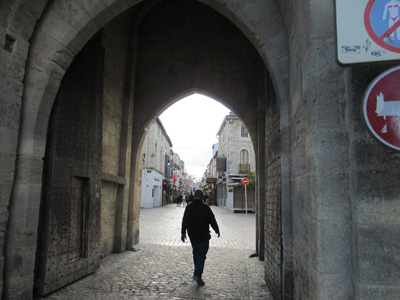
Aigues-Mortes
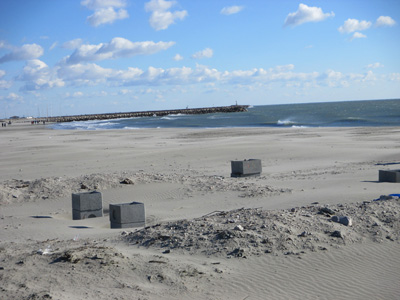
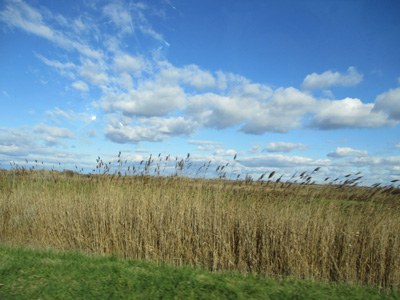
After we picked up our rental car from Brunhilde at Hertz, I had the bright idea of driving down to the Camargue, the huge flat delta that is the mouth of the Rhone (and bird-watcher central). It seemed an easy way to test the car before tackling the roundabouts and narrow historic centers of towns like Avignon. We drove through Arles toward Saintes-Maries-de-la-Mer, the small town that (legend has it) was the landing place for the 3 Marys after they left Jerusalem--and also their servant Sarah, patron saint of the "gypsies" of Europe. Stes. Maries seemed like a beach town, and it was incredibly windy, as a Mistral had begun to blow. And cold. So after walking out on the breakwaters at the beach, and being barely able to stand there without getting knocked over by the wind (and certainly not able to focus the binoculars for bird-watching), we got back in the car and drove west to Aigues-Mortes, Dead Waters, so-named because the waters never reached the city (ships were launched via canals).
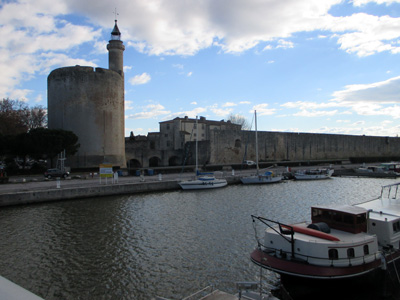
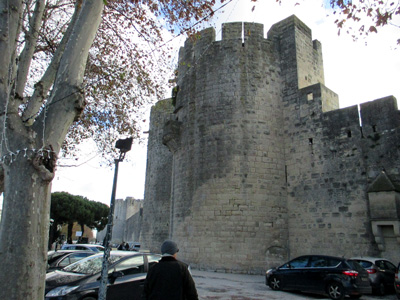
This walled city was built by Louis IX, in the 1200s, as a starting point for the 7th and 8th Crusades in 1248 and 1270 (see wikipedia.org). In addition to the wall, the biggest landmark is the huge round cornerstone Constance Tower, built by St. Louis on the site of an earlier tower built by Charlemagne.
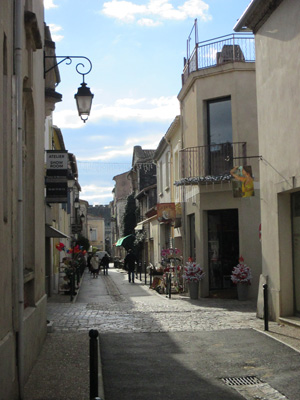
Main
street into Aigues-Mortes
Once you enter the arched gateway, you are greeted by fairly wide streets in a grid pattern, which sooner or later lead you past the golden walls to the Place de Louis in the center of town.
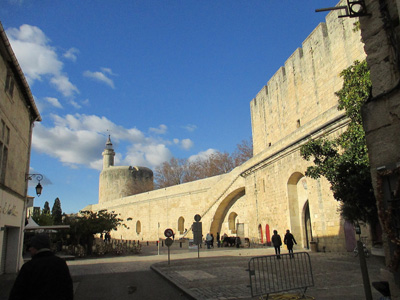
Walls from the interior, with Constance Tower
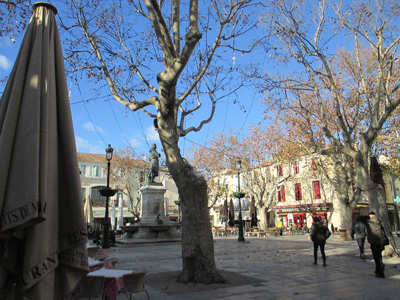
Place de Louis
For a fee, of course, you can climb the steep steps up to the wall, and walk the entire circumference of the city.