Diamond Crater
Before we hit the "high clearance" vehicular areas, we stopped by one of the landmarks of southeastern Oregon, the historic "Pete French Round Barn." Built in the 1870s by one of the settlers of the area, the barn is 100 feet in diameter. It has a 60-foot round stone corral surrounded by a 20-foot outer circle paddock with umbrella truss roof, and was used for breaking horses during the long Oregon winters (info from the traveloregon.com guide). It's also a great place for bird-watching (I saw 2 new flycatchers there.)
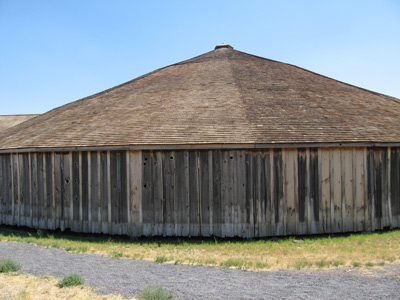
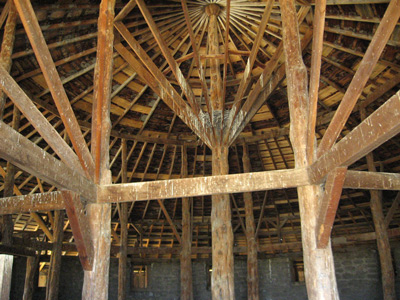
We first stopped at the Visitors' Center, where we met the barn's former owner, Dick Jenkins. Dick is a fifth-generation settler, who now runs the visitor center (and conducts tours). He was exceptionally helpful, and even gave us his card to call in case we got into trouble while touring the Diamond Craters. The Visitors' Center has all kinds of souvenirs, but their book collection was superb. I found what I had been looking for: a guide to Oregon geology (called Oregon Geology, by Orr and Orr).
Dick also explained to us that Harney County is one of the largest counties in the United States (I believe 3rd largest, at 10,000 square miles). It has a population of around 7,000, of which 90% live in Burns. That makes it the last frontier territory in the lower 48 states, based on population per square mile!
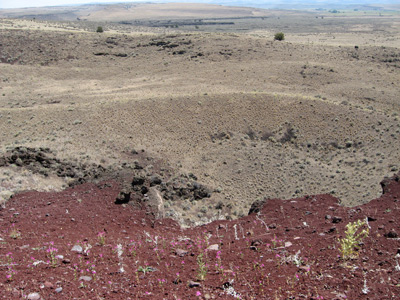
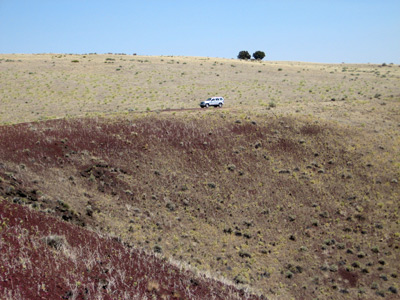
After the Round Barn, we back-tracked into the Diamond Craters area. At first it was difficult to tell where the road was, and which way to drive, but after a little testing, we got the hang of it (look for the numbered markers, and don't hesitate to back down any route that doesn't seem safe!). After identifying the Graben Dome, we started with the Big Bomb Crater, then continued to the Lava Pit Crater, the Red Bomb Crater (up Jackass Mountain), East and West Twin Craters, Dry Maar and Malheur Maar.
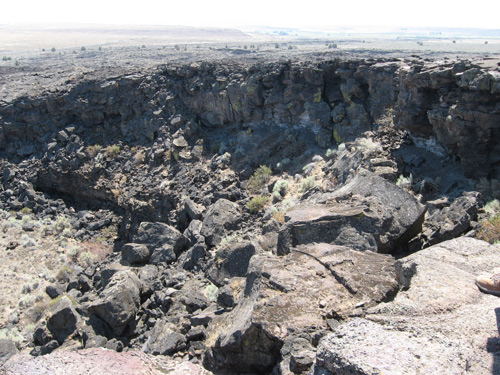

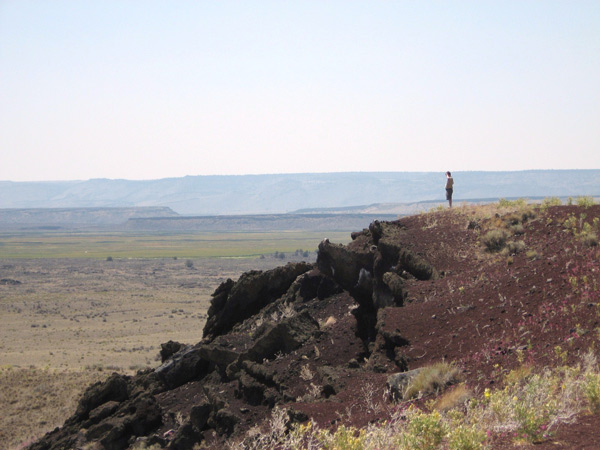

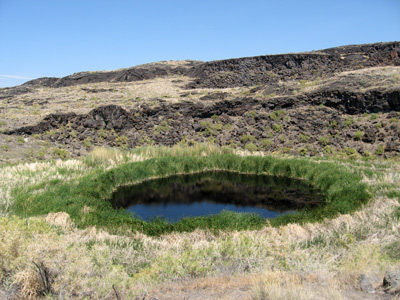
The bird-watching was especially good in the Malheur Maar. You can't tell from this picture how BIG it is and how deep. There were coots, red-wing blackbirds, herons, and more hiding in the lush grasses.