The Celios and the Appian Way
This had to be one of the highlights of my trip. We walked down Via Merulana, past San Giovani in Laterano (the "mother of all churches" and the first Christian basilica in Rome), through the Baths of Caracalla, and down the Appian Way through the city gates of ancient Rome.

St. John in Lateran Basilica
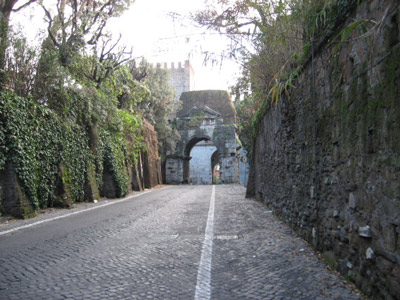
The Porta San Sebastiano is the best preserved gate in what is called the "Aurelian Wall." Walk through that gate, and you are on the road to Capua, then Benevento, finally Brindisi. You don't see in this photo that the road is in constant use today, and the walkers' area is that thin part of either side. Behind these forbidding walls were crypts, villas, and gardens.
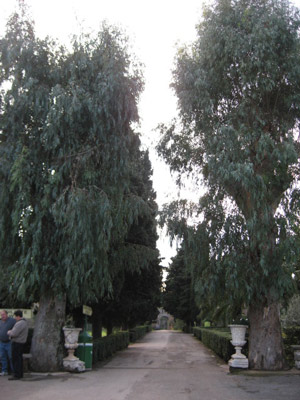
Our goal on this hike was to reach the catacombs. There were three we wanted to visit: Catacombe di San Callisto (with its Cripta dei Papi, or Crypt of the early Popes), Catacombe di Domitilla (closed for the holidays), and Catacombe di San Sebastiano.
Along the way we passed the Church of Domine Quo Vadis (Where To, Lord?), where (according to my guidebook) the Apostle Peter is said to have asked Jesus this question; Jesus replied "To let myself be crucified a second time" (referring to Peter's impending death, I think). Jesus is said to have left his footprints on the road, which are now preserved in the church at the Catacombs of St. Sebastian.
The first catacomb we came to was St. Callisto, where St. Cecilia was said to have been buried. They were very well organized, with separate hourly tours in English, Spanish, Russian, German, French, and other languages (no pictures allowed inside). We wound our way through the deep, dark tunnels and were happy we had a guide to get us back out.
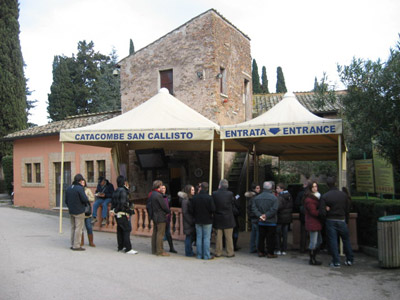
Then we walked to Domitilla, only to find it closed for a month. It was getting late, but we decided to try to reach St. Sebastian, and got there just in time for the last tour. It was a lot of fun (they had left a couple of preserved bodies for tourists to see), including a bonus of some Roman burial crypts as well under the church.
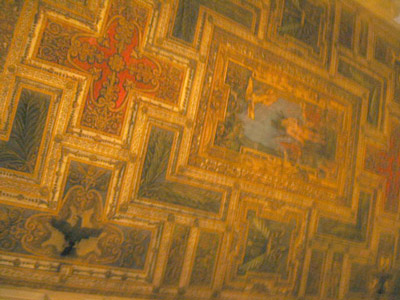
The church itself was splendid (though dark), with an incredibly engraved wooden ceiling.
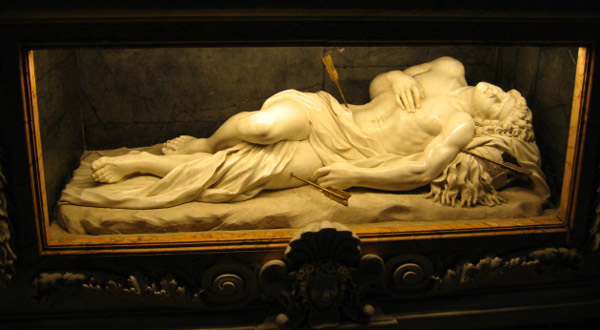
The church is the burial place of St. Sebastian, and his tomb is covered with an incredibly sensuous sculpture of the saint (note the arrows piercing his thigh, arm, and side). In other parts of the church are some preserved arrows, as well as Jesus' footprints from the Quo Vadis church.